Sampling and preparation
Where does hands-on work add up?
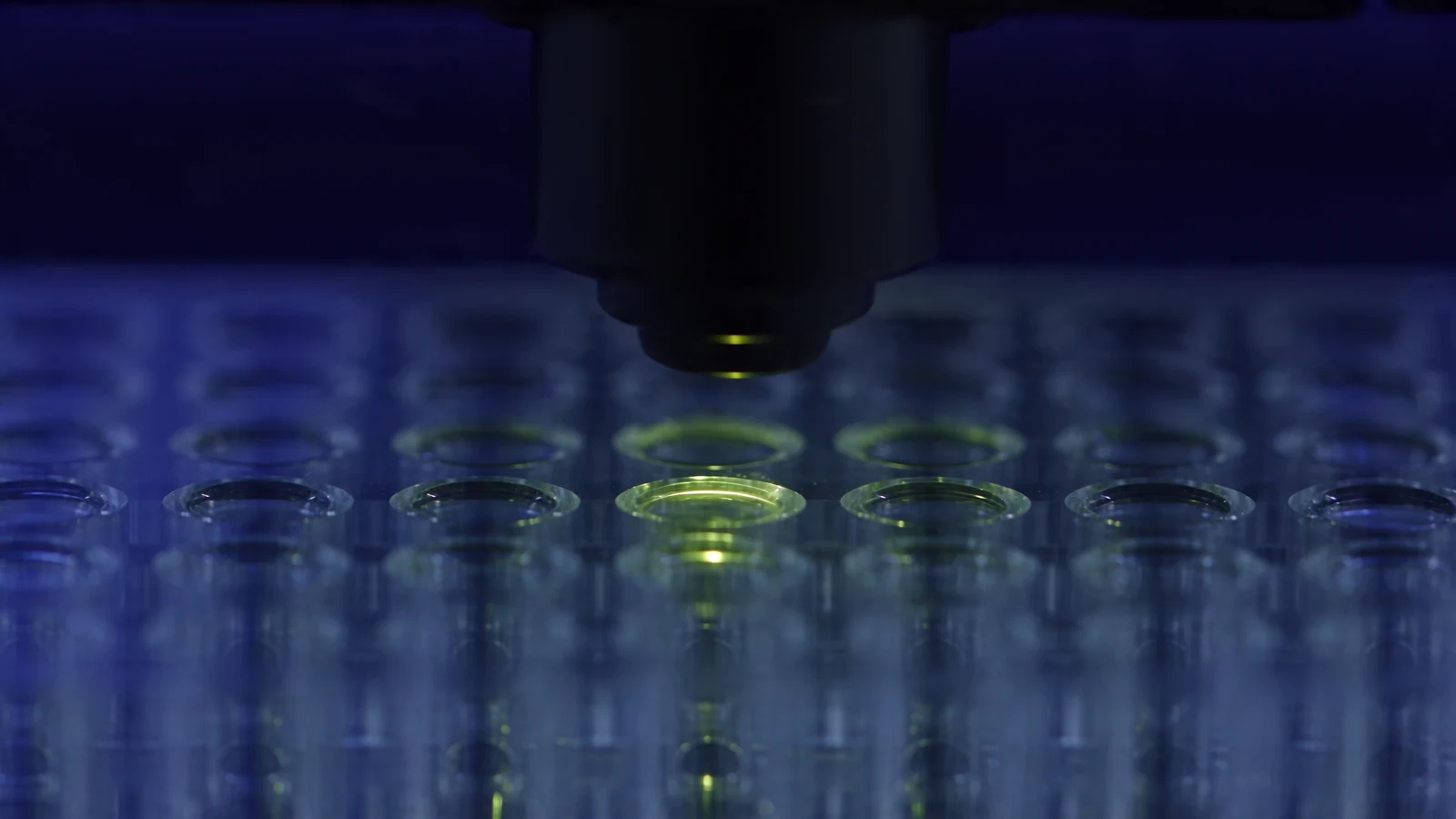
Which recurring sampling or preparation steps take time, consume materials or limit how much work a team can do? What does the current method already handle well?
Research notebook / September 2026
We are investigating how better measurement and automation could make biological production more predictable and economical. We are starting with cell-culture measurement and process development, learning from the people doing the work.
Three questions guiding the work
We want to understand where an improvement would save time or materials, support a better decision, or make a result more reliable. These are open questions to test against actual workflows and existing tools.
Sampling and preparation
Which recurring sampling or preparation steps take time, consume materials or limit how much work a team can do? What does the current method already handle well?
Useful measurements
Where are measurements too slow, incomplete or difficult to use for an important process decision? What would a better measurement need to show to earn the team's trust?
Repeatability
When methods move between instruments, teams or development stages, what remains reliable and what needs repeating? Where could a more consistent method make a useful difference?
Why we reached out
Mike asks practitioners about the details that published research and product descriptions cannot answer.
Your experience helps us understand what happens in practice, which tools already work well, and where an engineering improvement might be useful. We also continue to explore related questions in tissue experiments, sample preparation and reagents.
Plixo is led by Michael (Mike) Ochs, whose background is in AI and engineering. We are looking for a specific problem worth solving and a result we can test with qualified scientific collaborators.
A short reply to Mike's email is enough. Share an example or challenge our assumptions. This is independent research. Any future biological product, laboratory service or method needs its own development and validation.
Selected reading
Public work informing our research. The organizations below are not Plixo partners or customers.
Isomorphic Labs · Max Jaderberg · August 2023
Describes bringing machine learning experience into biology through scientific immersion and interdisciplinary work. Our takeaway: learn the domain with practitioners before choosing the technical solution.
Opentrons · Existing vendor services
Opentrons offers custom protocol development, code validation and setup guidance for its own hardware. Third-party equipment is outside that service's scope. Our takeaway: compare existing vendor support first, then establish whether a remaining workflow or integration gap justifies new work. Code validation and biological performance need distinct acceptance criteria.
Sartorius · Existing bioprocess tools
Sartorius describes automated parallel bioreactors and integrated measurements for process development. Our takeaway: understand what established equipment already solves, then ask practitioners where a meaningful gap remains.
The next step
A recent example, a current workaround,
or a reason our
assumptions are wrong.